How Much Does It Cost to Start a Junk Removal Business?
Share
How Much Does It Cost to Start a Junk Removal Business in 2026?
If you're thinking about starting a junk removal business, one of the first questions you're probably asking is, "How much does it actually cost?"
The good news is that a junk removal business is one of the most affordable home service businesses to start. Unlike restaurants, retail stores, or franchises that often require six-figure investments, you can launch a junk removal company for a fraction of the cost.
Even better, you don't need a fleet of trucks or a warehouse to get started. Many successful junk removal companies began with nothing more than a pickup truck, a trailer, and a commitment to providing excellent customer service.
In this guide, we'll break down every major startup expense, show you different budget scenarios, and explain where you should—and shouldn't—spend your money. We'll also share how you can avoid costly beginner mistakes by using a complete junk removal business starter kit.
Average Cost to Start a Junk Removal Business
The total cost depends on what equipment you already own.
Here are realistic startup ranges for 2026:
| Startup Level | Estimated Cost |
|---|---|
| Budget Startup (Own a Truck) | $2,000–$6,000 |
| Standard Startup | $8,000–$20,000 |
| Premium Startup (New Truck) | $30,000–$70,000+ |
Many first-time business owners start somewhere between $5,000 and $15,000, especially if they already own a reliable pickup truck.
The biggest expense is almost always your vehicle.
Business Registration Costs
Before taking your first customer, you'll need to legally establish your business.
Typical expenses include:
- LLC registration
- Business license
- Employer Identification Number (EIN)
- Local permits (if required)
Depending on your state, these costs usually range from $100 to $800.
While it might be tempting to operate as a sole proprietor, forming an LLC helps protect your personal assets and presents a more professional image to customers.
Vehicle Costs
Your vehicle is the foundation of your business.
Fortunately, you have several options depending on your budget.
Option 1: Pickup Truck
Many entrepreneurs start with a truck they already own.
This is the least expensive option and works well for small cleanouts.
Estimated cost:
$0–$15,000 (if purchasing used)
Option 2: Pickup Truck with Trailer
Adding a trailer dramatically increases your hauling capacity without buying a larger truck.
Estimated trailer cost:
- Utility trailer: $2,000–$4,000
- Dump trailer: $8,000–$15,000
Many experienced junk removal operators recommend this option because it offers an excellent balance between affordability and capacity.
Option 3: Box Truck
A box truck looks more professional and holds larger loads.
However, it's also the most expensive startup option.
Estimated cost:
- Used box truck: $15,000–$40,000
- New box truck: $50,000–$90,000
Unless you already have customers lined up, most beginners are better off starting smaller and upgrading later.
Insurance Costs
Insurance is not something you should skip.
At minimum, you'll likely need:
- General liability insurance
- Commercial auto insurance
- Workers' compensation (if hiring employees)
Typical monthly costs range from $150 to $500, depending on your location and coverage.
Commercial customers often require proof of insurance before awarding contracts.
Equipment You'll Need
You don't need expensive machinery.
Basic equipment includes:
- Heavy-duty gloves
- Safety glasses
- Moving blankets
- Furniture dollies
- Appliance dolly
- Ratchet straps
- Bungee cords
- Shovels
- Rakes
- Hand tools
- Power drill
- Bolt cutters
Expect to spend between $500 and $2,000 on quality equipment.
Buying durable tools now will save money over time.
Marketing Costs
No customers means no business.
Marketing should be part of your startup budget from day one.
Essential investments include:
- Professional logo
- Business cards
- Yard signs
- Truck magnets or vehicle wrap
- Google Business Profile optimization
- Website
- Local SEO
- Social media setup
Many new businesses spend between $500 and $3,000 getting their marketing in place.
Remember, marketing is an investment—not an expense.
Website Costs
In 2026, customers expect every legitimate business to have a professional website.
Your website should include:
- Services
- Pricing information
- Service areas
- Online quote request
- Customer reviews
- Contact information
A professional website typically costs between $500 and $3,000, although many entrepreneurs build their own using platforms like Shopify or WordPress for much less.
A well-optimized website can become your best salesperson, generating leads 24 hours a day.
Dump Fees
Every junk removal job includes disposal costs.
These vary by location and the type of material you're hauling.
Common disposal expenses include:
- Municipal landfill fees
- Transfer station fees
- Recycling center fees
Many operators build these costs directly into their pricing rather than charging customers separately.
Understanding your local disposal costs is essential for protecting your profit margins.
Fuel Costs
Fuel is one of your largest ongoing operating expenses.
The farther you travel, the more it affects profitability.
Planning efficient routes and grouping nearby jobs together helps reduce fuel expenses while allowing you to complete more jobs each day.
Software and Administrative Costs
Running a professional business also requires a few digital tools.
Examples include:
- Scheduling software
- Invoicing software
- Accounting softwareြ/li>
- Customer relationship management (CRM)
- Business phone number
- Email hosting
Fortunately, many of these services are affordable and can grow with your business.
Unexpected Expenses
Every business has surprises.
You should keep an emergency fund for:
- Vehicle repairs
- Tire replacements
- Equipment replacement
- Insurance deductibles
- Slow seasons
Having cash reserves reduces stress and allows you to keep operating when unexpected expenses arise.
Can You Start With Less Than $5,000?
Absolutely.
Many successful junk removal businesses started with:
- A used pickup truck
- Basic moving equipment
- A Facebook page
- A free Google Business Profile
- Business insurance
- Hard work
As revenue grows, owners reinvest profits into trailers, better equipment, and marketing.
Starting lean often teaches valuable lessons while reducing financial risk.
Where Beginners Waste Money
Many first-time entrepreneurs overspend before they ever get their first customer.
Common mistakes include:
Buying a brand-new truck.
Renting office space.
Purchasing expensive software they don't need.
Ordering thousands of printed flyers before validating their marketing.
Paying for large advertising campaigns before their website is ready.
The goal isn't to look like the biggest company—it's to become the most profitable one.
The Hidden Cost of Starting From Scratch
Many people focus only on equipment costs but overlook the value of time.
Creating contracts.
Building estimate forms.
Designing invoices.
Writing service agreements.
Developing pricing sheets.
Learning marketing.
Building operating procedures.
All of this can take weeks—or even months—to figure out on your own.
Time is money.
The faster you launch, the sooner you start generating revenue.
Why a Junk Removal Business Starter Kit Can Save You Thousands
One of the smartest investments you can make isn't another piece of equipment—it's a proven business system.
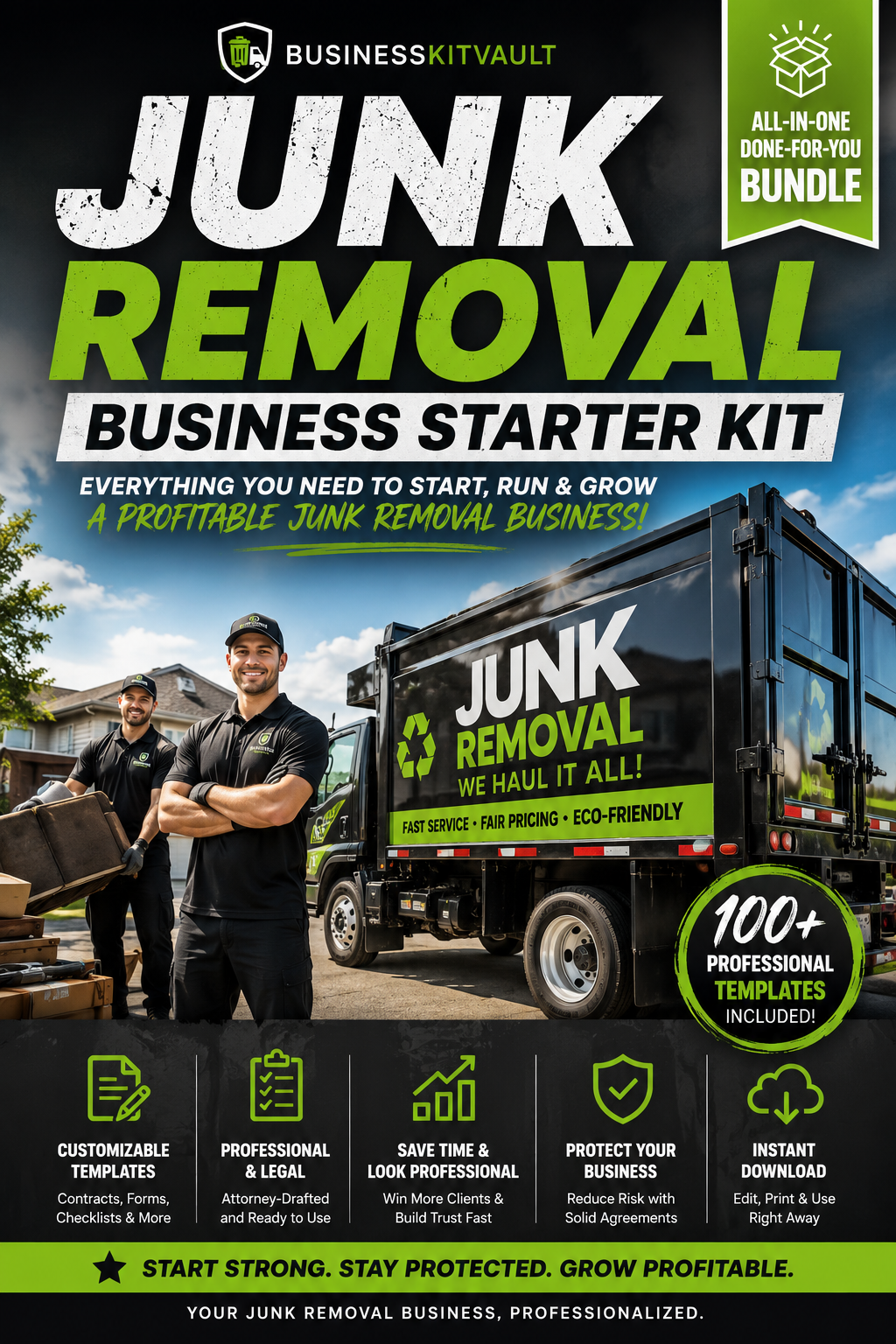
A comprehensive Junk Removal Business Starter Kit gives you everything needed to launch professionally without spending months creating documents from scratch.
Instead of Googling templates or paying hundreds of dollars for custom forms, you'll receive professionally designed resources like:
- Customer contracts
- Estimate templates
- Invoice templates
- Pricing worksheets
- Proposal templates
- Work orders
- Safety forms
- Marketing checklists
- Business startup guides
- Operational documents
Rather than reinventing the wheel, you can focus on what actually makes money—getting customers and completing jobs.
For many new business owners, a starter kit pays for itself after the very first job.
Final Thoughts
Starting a junk removal business in 2026 doesn't require hundreds of thousands of dollars or years of experience. Depending on your situation, you can realistically launch with as little as $2,000 to $6,000 if you already own a truck, or invest more if you're planning a larger operation.
The most successful entrepreneurs don't necessarily spend the most—they spend wisely. They prioritize reliable equipment, professional branding, strong marketing, and efficient systems that allow them to serve customers and grow profitably.
If you're ready to skip the guesswork and launch with confidence, our Junk Removal Business Starter Kit gives you the forms, templates, pricing guides, contracts, checklists, and resources you need to start faster and look professional from day one.
Instead of spending weeks building your business from scratch, you can focus on booking your first jobs, earning your first revenue, and building a junk removal company that's ready to grow.